
From Discovery to Better Health: Research Across the Translational Spectrum
August 7, 2026
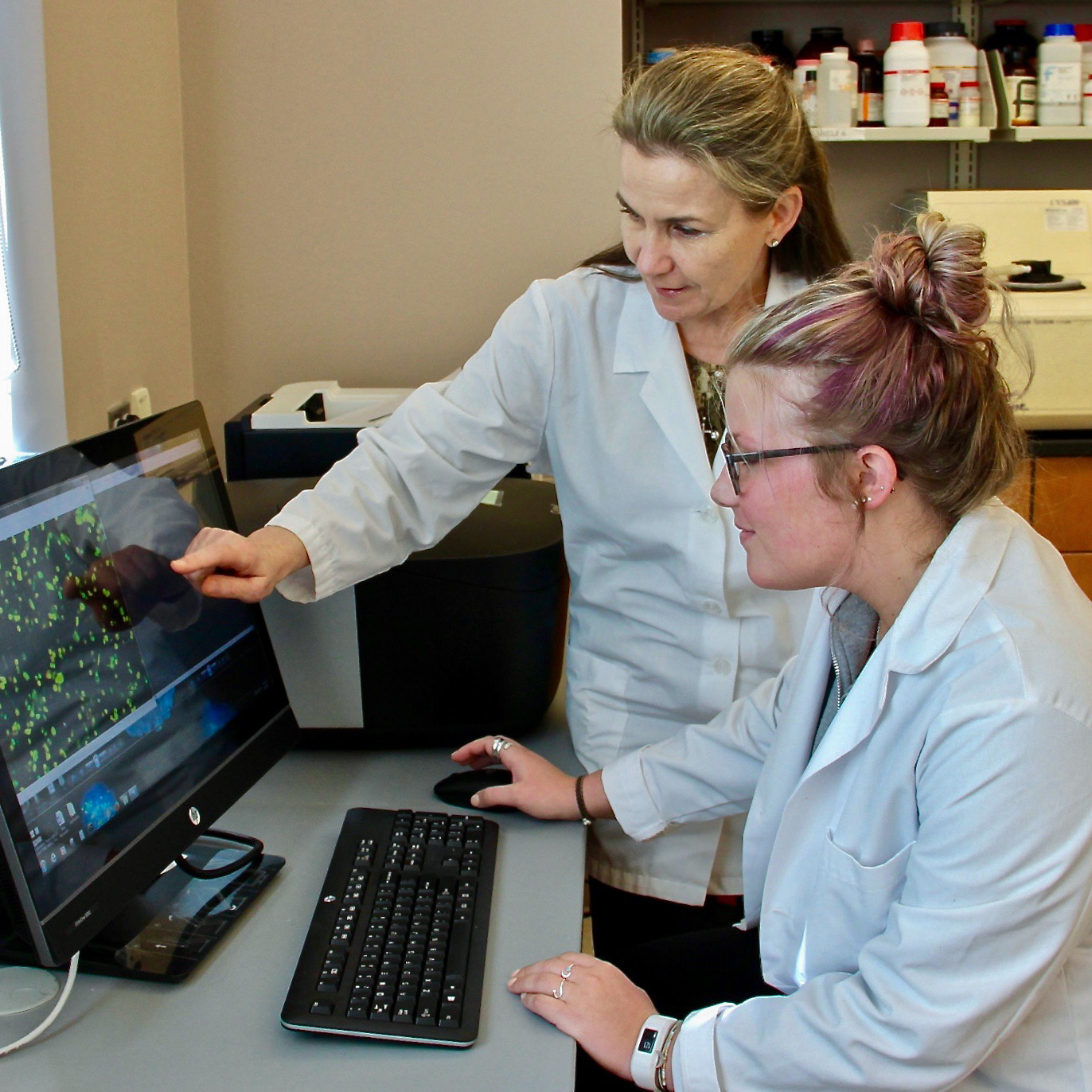
Translational research continuum (noun): A framework that describes the process of advancing scientific discoveries from foundational laboratory research to real-world applications that improve human health. Each stage builds on the one before it, creating a continuum of research often described in five phases, from T0 to T4.
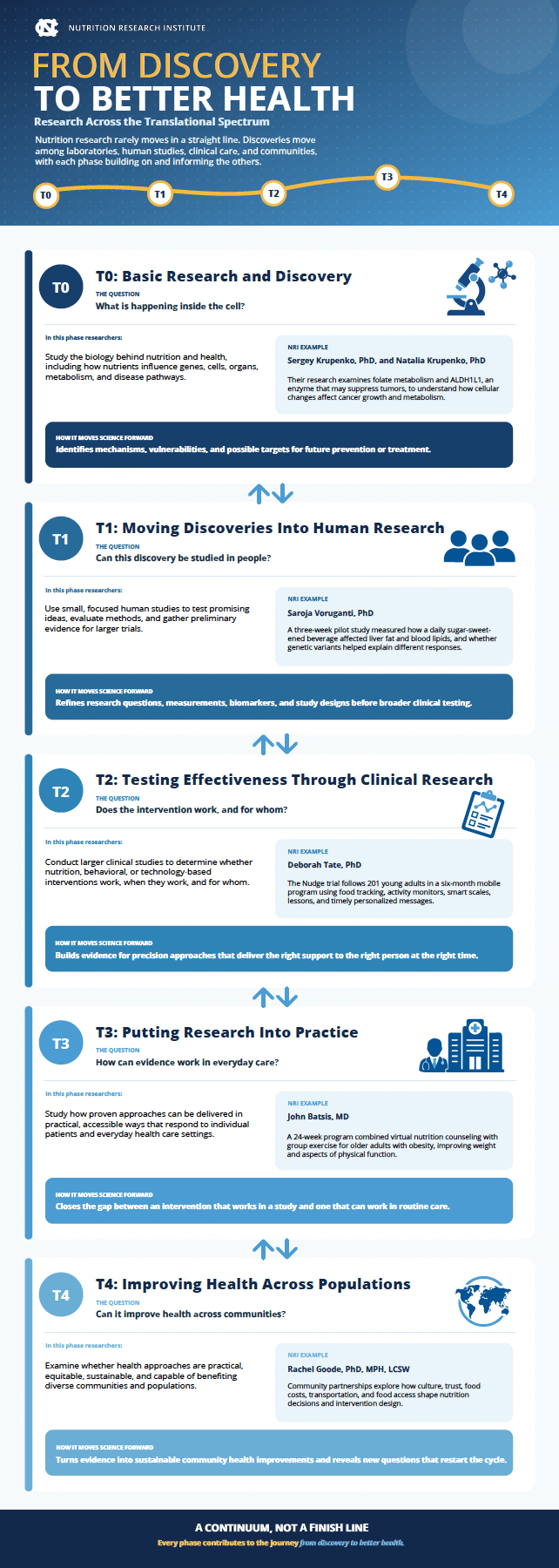
Click the image above to see the practical application of research across the translational spectrum.
Nutrition research rarely moves in a straight line. A discovery made in a laboratory may lead to a study in people, which may later inform clinical care, public health guidance, or community programs. Each step builds on the one before it, creating a continuum known as translational research.
This continuum is often described in five phases, from T0 to T4. Together, they show how scientific questions can move from basic discovery to real-world improvements in health.
At the UNC Nutrition Research Institute, researchers work across this spectrum. Some investigate the molecular and biological mechanisms that shape health. Others test nutrition interventions in people, develop tools for clinical care, or examine how research can be applied across communities and health systems.
No single researcher or study represents the entire translational continuum. Instead, scientists contribute at different points, often working across several phases at once. The work of six NRI researchers offers a window into how nutrition science can move from molecular discovery to clinical care and population health.
T0: Basic Research and Discovery
The translational process begins with fundamental questions.
At the T0 stage, researchers study the biology behind effects of nutrition on health. They typically investigate how nutrients affect genes, cells, organs, metabolism, or disease conditions. This work often uses laboratory models, genetic analysis, or biological samples to identify mechanisms that may eventually become targets for prevention or treatment.
Natalia Krupenko, PhD, and Sergey Krupenko, PhD, investigate folate, also known as vitamin B9, and its role in one-carbon metabolism, a network of biochemical reactions which enable cell proliferation and functioning through the control of energy utilization, gene expression and DNA replication.
Their work explores a complex question: How can folate be essential for health while also supporting the growth of some cancers? Recent studies have focused on ALDH1L1, the enzyme involved in folate metabolism that may help suppress tumors. By examining how changes in this enzyme affect cancer cell metabolism and tumor growth, the researchers are identifying biological mechanisms that could eventually point to new treatment strategies and nutritional intervention.
This early-stage work does not immediately produce a new treatment or nutrition recommendation. However, it identifies the mechanisms, vulnerabilities, and potential targets that later phases of translational research can investigate. Before scientists can test a new approach in people, they must first understand what is happening inside the cell.
T1: Moving Discoveries Into Human Research
Once researchers identify a promising biological mechanism, biomarker, intervention, or target, the next step is determining whether it can be studied safely and effectively in people.
At the T1 stage, researchers conduct small, focused human studies to test an idea, evaluate research methods, and gather the preliminary evidence needed for larger trials. Saroja Voruganti, PhD, studies nutritional genomics, examining how genetic differences influence the way individuals process nutrients and their risk for metabolic disease.
In one pilot study, her team asked participants to consume a sugar-sweetened beverage each day for three weeks. Researchers measured changes in liver fat and blood lipids and examined whether genetic variants helped explain why people responded differently to the same amount of sugar. The study found several potential gene-related differences, although the small sample means the results must be tested in larger and longer studies.
This phase helps researchers determine which questions, measurements, and genetic markers are most promising before moving into broader clinical evaluation. It allows scientists to refine their study design by identifying which biological signals are most sensitive to dietary change and which outcomes are most meaningful to track over time. Researchers can also evaluate whether their methods for collecting genetic and metabolic data are reliable and practical in real-world settings. By narrowing down the most informative variables at this stage, T1 studies reduce uncertainty and improve the likelihood that later, larger clinical trials will produce clear and actionable results.
T2: Testing Effectiveness Through Clinical Research
T2 research asks whether an intervention works—and for whom.
At this stage, researchers conduct clinical studies to evaluate nutrition, behavioral, or technology-based approaches and measure their effects on health. Deborah Tate, PhD, develops digital weight-management interventions that use mobile technology, wearable devices, and personalized support to help people build healthier habits.
One example is the AGILE study, a randomized trial in which 600+ young adults with overweight or obesity are participating in a six-month program delivered through a mobile app. The study combines food tracking, activity monitors, smart scales, weekly lessons, and messages delivered at moments when participants may need support. Researchers are testing which combinations of these components are most effective for improving behaviors such as healthy eating, physical activity, and self-weighing, and how the intervention can be optimized for individual needs.
This phase is central to precision nutrition because the same intervention may not work equally well for everyone. By comparing participants’ behaviors and outcomes, researchers can begin tailoring programs to provide the right support to the right person at the right time.
T3: Putting Research Into Practice
Evidence alone does not automatically change health care. T3 research examines how proven approaches can be delivered in ways that are accessible, practical, and responsive to patients’ needs.
John Batsis, MD, studies how nutrition, exercise, telemedicine, remote monitoring, and other technologies can support healthy aging. In one program, older adults with obesity participated in a 24-week intervention that combined virtual nutrition counseling with group exercise led by physical therapists. Participants lost weight and improved aspects of physical function, but their individual responses varied considerably.
That variation is especially important for older adults, for whom weight loss must be balanced with maintaining muscle, strength, mobility, and independence. Dr. Batsis’s work explores how care can be tailored using clinical information, technology, and individual health profiles rather than applying the same approach to everyone.
By studying how these interventions can be delivered remotely and adapted to different patients, T3 research helps close the gap between an approach that works in a study and one that can be used effectively in everyday care.
T4: Improving Health Across Populations
The final phase examines what happens when research reaches communities and encounters the realities of everyday life.
T4 research asks whether health approaches are practical, equitable, and capable of benefiting diverse populations. Rachel Goode, PhD, MPH, LCSW, develops community-engaged interventions for obesity and eating disorders, with particular attention to the cultural and structural factors that shape health.
Her team works with local organizations and families to understand how cultural values, trust, mental health, transportation, and access to healthy food influence nutrition decisions. These partnerships help researchers design interventions that reflect the needs and experiences of the people they are intended to serve.
By examining both individual behavior and the conditions surrounding it, Goode’s work helps move nutrition research toward sustainable improvements in community health.
T4 research also creates new questions. Real-world results may reveal that an intervention needs to be adapted for different populations or that biological differences influence outcomes. Those observations can send researchers back to the laboratory, beginning the translational cycle again.
A Continuum, Not a Finish Line
The phases of translational research are often presented in order, but scientific progress is not always sequential. A clinical trial may uncover a biological question that leads back to basic research. A community program may reveal a barrier that requires a new intervention. A laboratory discovery may help explain why people respond differently to the same diet.
That continuous exchange is essential to the NRI’s work.
By bringing together basic scientists, clinical researchers, behavioral experts, health professionals, research participants, and community partners, the institute can approach nutrition and health from multiple directions.
The goal is not simply to make discoveries. It is to understand how those discoveries can be tested, refined, applied, and used to improve human health.
From T0 to T4, every phase contributes to that journey.
T0 — Natalia Krupenko and Sergey Krupenko
Meyers HM, Sharma J, Abdellatef AA, et al. Differential Expression of One-Carbon Pathway Enzyme ALDH1L1 Is Linked to Tumorigenicity of Low-Grade Bladder Cancer Cells Through Metabolic Reprogramming. Cancer Medicine. 2025;14(19):e71291. doi:10.1002/cam4.71291.
PMID: 41070972
T1 — Saroja Voruganti
Jeyaraj FT, Vennam SS, Nelson K, et al. NAFLD-related SNPs are linked to changes in liver fat, as measured by the CAP score, and serum lipids in response to a 3-week sugar-sweetened beverage intervention: a pilot study. Food & Function. 2026. doi:10.1039/D5FO03248B.
PMID: 41810674
T2 — Deborah Tate
Nezami BT, Valle CG, Wasser HM, Hurley L, Hatley KE, Tate DF. Optimizing a mobile just-in-time adaptive intervention (JITAI) for weight loss in young adults: Rationale and design of the AGILE factorial randomized trial. Contemporary Clinical Trials. 2025;150:107808. doi:10.1016/j.cct.2025.107808.
PMID: 39824380
T3 — John Batsis
Tharwani SD, Lynch DH, Boccaccio DE, et al. Leveraging precision medicine analytics to optimize inflammation reduction and enhance physical function in older adults. The Journals of Gerontology: Series A. 2026;81(4):glag053. doi:10.1093/gerona/glag053.
PMID: 41719202
T4 — Rachel Goode
Vereen RN, Hall MG, Dillman Carpentier F, Goode RW, Noar SM, Lazard AJ. The impact of culturally-informed messages to reduce sugar-sweetened beverage consumption: An experiment among Black women in the United States. PLOS ONE. 2024;19(11):e0312361. doi:10.1371/journal.pone.0312361.
Share on Socials
Inspired By What You Read?
NRI scientists are discovering how genes, environment, and microbiome affect our individual requirements for nutrients so that, soon, medical practitioners will be able to guide people in their health from childhood through old age without adding to these tragic numbers. Our critical research depends on the generosity of people like you.