
Passing Science Forward: How NRI Researchers Teach the Next Generation
October 2, 2026
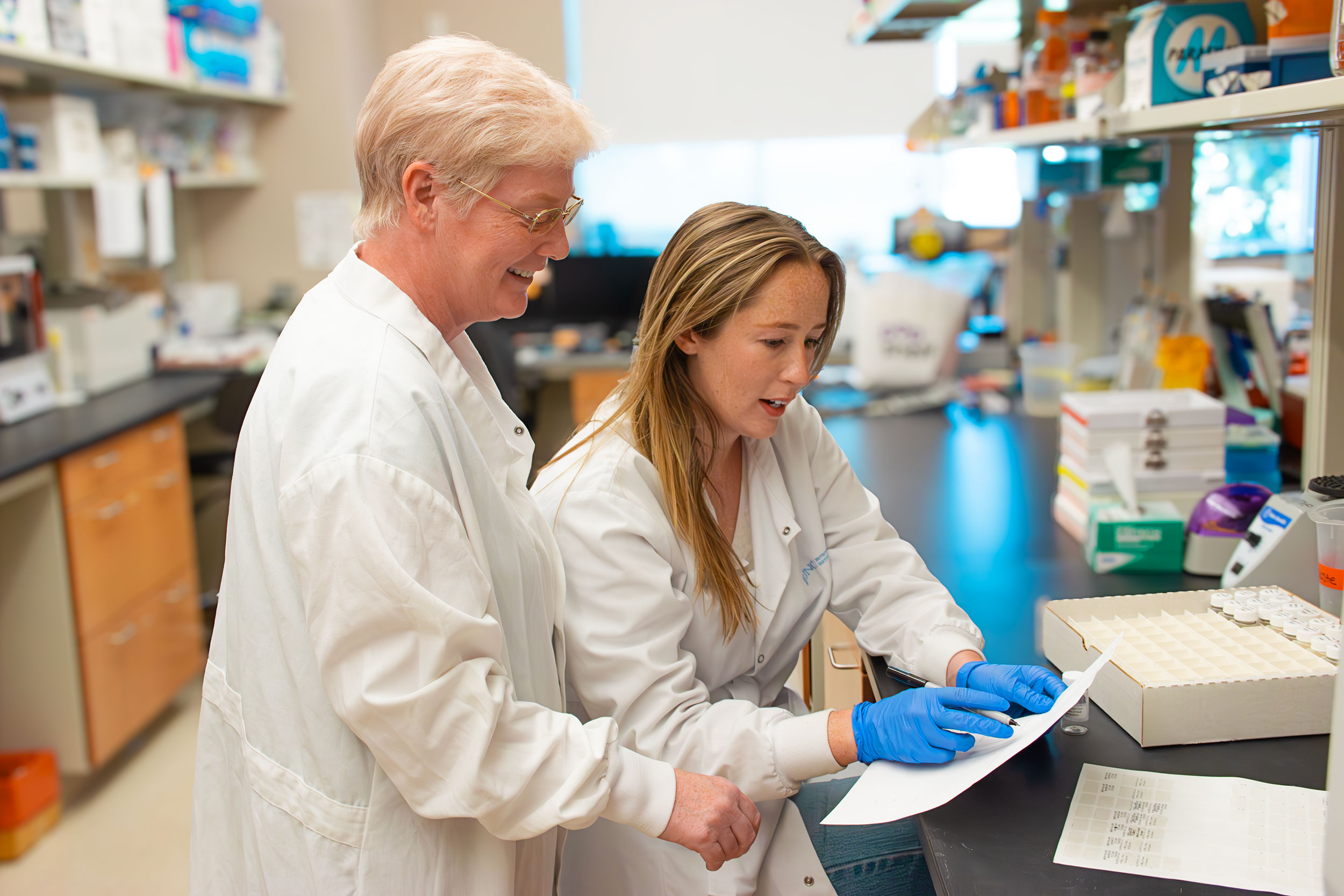
NRI faculty wear many hats. In addition to leading research, they teach UNC-Chapel Hill courses, mentor graduate students, train young scientists in the laboratory, and help students develop the skills needed to pursue research questions of their own.
On any given day at the UNC Nutrition Research Institute, a principal investigator may move from analyzing study results to meeting with a doctoral student, reviewing a manuscript, troubleshooting an experiment, or teaching a class based more than 100 miles away in Chapel Hill.
Research may be at the center of the NRI’s mission, but teaching is woven throughout it. NRI scientists serve as professors, advisers, mentors, and trainers, helping students understand not only what science already knows, but how to ask the questions that may lead to what comes next.
In recognition of World Teachers’ Day, we are highlighting another side of the scientists behind NRI research: the teachers helping prepare the next generation.
Teaching extends beyond the classroom
Many NRI faculty teach across UNC-Chapel Hill’s nutrition curriculum, covering topics that include nutritional epidemiology, metabolism, micronutrients, biochemistry, nutrigenomics, and precision nutrition.
Their research experience allows them to bring current science directly into the classroom. Students are not simply learning concepts from textbooks; they are learning from scientists who are actively investigating many of those same questions.
For Nipun Saini, PhD, teaching offers an opportunity to show students that science is not a collection of fixed answers, but an ongoing process of questioning and discovery.
“I hope students understand that textbooks provide foundational and theoretical knowledge, while research is truly ‘re-search’—we ask questions, test ideas, and often have to revisit and repeat studies before we can establish what is reliable and meaningful. Being actively engaged in research allows me to bring the most current scientific questions, challenges, and discoveries into the classroom, rather than teaching only what has already been established.” — Nipun Saini, PhD, Assistant Professor of Nutrition
The laboratory is a classroom, too
Some of the NRI’s most intensive teaching happens outside a traditional classroom.
Doctoral students working in NRI laboratories learn how to design studies, collect and interpret data, troubleshoot experiments, communicate findings, critique scientific literature, write manuscripts, and develop research questions of their own.
That process often looks very different from traditional instruction. Rather than simply being given an answer, students are challenged to think through problems, test possible solutions, and become more confident making decisions on their own.
For Meng Lai, a doctoral student in the Rushing Lab, that process has changed the way he approaches scientific challenges.
“My mentor taught me to approach scientific questions with the bravery to be wrong, while remaining open to alternative solutions in the field. Now, whenever I encounter a question or difficulty, I see it as an opportunity to learn and improve.”— Meng Lai, Doctoral Student, Rushing Lab
That gradual move toward independence is exactly what Blake Rushing, PhD, hopes to see as students progress through their training.
“Independence doesn't happen all at once. It shows up in small moments, like when a student troubleshoots an experiment on their own, reads a paper and sees a gap nobody has filled, or teaches another lab member how to perform an experiment. Those are the moments that tell me they're ready to start developing their own ideas. That doesn't mean they're on their own. Good science is collaborative, and input from me and others in the lab continues to shape and strengthen their work.”— Blake Rushing, PhD, Assistant Professor of Nutrition
Learning goes both ways
Mentorship is not entirely one-directional. Students bring new ideas, questions, perspectives, and approaches into the laboratory, and faculty often learn from the people they mentor.
For Sandra Mooney, PhD, those questions can lead faculty to examine their own thinking more closely.
“Students asking ‘why’ require a carefully thought out and logical response. Sometimes this helps us identify weaknesses or novel questions, catalyzing breakthrough innovation and, ultimately, advancement in the field. I enjoy knowing that I can learn as much from students as I teach them.”— Sandra Mooney, PhD, Associate Professor of Nutrition
That emphasis on understanding the “why” behind the science is something her students carry into their own work.
“My mentor has helped me feel more confident as a scientist by ensuring that I fully understand the ‘why’ behind every experiment. It's important to not just go through the motions but to fully understand the mechanism of each experiment and how the data can then be translated into the population. Bench to practice!”— Hannah Petry, Doctoral Student, Mooney Lab
Preparing the scientists who come next
The ultimate goal of mentorship is not simply to help a student complete an experiment or earn a degree. It is to prepare them to lead studies, solve problems, mentor others, and contribute knowledge of their own.
For faculty, one of the rewards is seeing students take what they have learned and begin succeeding independently.
“The most rewarding part is seeing a student develop the confidence and skills to ask their own questions, make decisions independently, and succeed as a scientist. It is gratifying to know that your training helped prepare them for that.”— Saroja Voruganti, PhD, Professor of Nutrition
The discoveries made at the NRI today may influence nutrition science for years to come. But so will the scientists being trained alongside them.
Every course taught, experiment discussed, manuscript reviewed, and question asked contributes to that next generation. At the NRI, teaching is not separate from research. It is one of the ways science moves forward.
Share on Socials
Inspired By What You Read?
NRI scientists are discovering how genes, environment, and microbiome affect our individual requirements for nutrients so that, soon, medical practitioners will be able to guide people in their health from childhood through old age without adding to these tragic numbers. Our critical research depends on the generosity of people like you.