
Could Choline Help Protect the Brain Before Alzheimer's Begins?
November 12, 2026
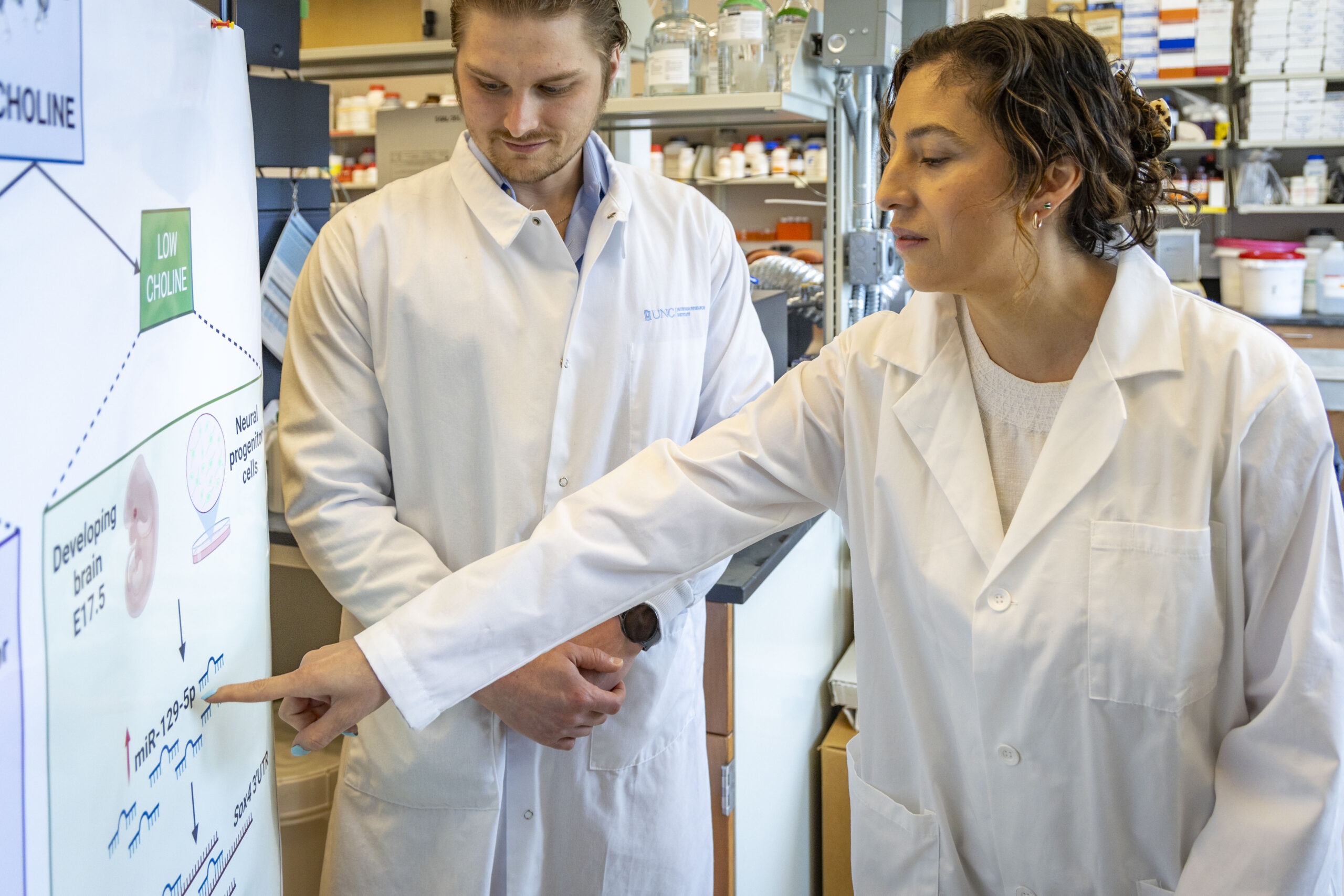
Isis Trujillo-Gonzalez, PhD, is an Assistant Professor at the University of North Carolina at Chapel Hill’s Nutrition Research Institute (NRI). She joined the NRI in 2015 to conduct her postdoctoral research under Steve Zeisel mentoring. She earned her PhD in Biomedical Sciences from the National Autonomous University of Mexico (UNAM). Her lab employs molecular and neuroscience methodologies to investigate the impact of choline on brain function and health.
The strongest genetic risk factor for late-onset Alzheimer’s disease is a version of a gene called APOE e4. Alzheimer’s can begin changing the brain years, even decades, before memory problems appear. For people who carry APOE ε4, this long window raises an important question: Could knowing their genetic risk give them an opportunity to make changes before symptoms begin?
To understand why researchers are interested in choline, we first need to understand what APOE does. Think of APOE as a delivery truck that helps transport fats within the brain. These fats are essential for keeping brain cells healthy, but they need to be moved and processed properly. APOE e4 is like a truck that does not do its job efficiently, contributing to the accumulation of fats where they should not be. Previous studies using human cells found that choline, an essential nutrient used to make phosphatidylcholine, a type of fat important for cell membranes and lipid metabolism, could correct some of these disruptions. Yet only 8% of older Americans consume the recommended amount of choline.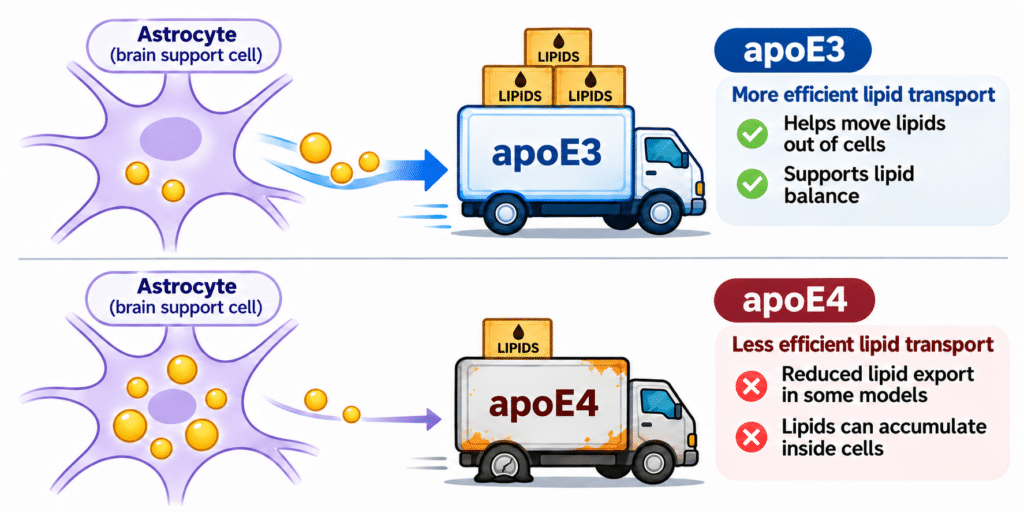
This led researchers to an intriguing possibility: Could providing more choline help compensate for some of the problems associated with APOE e4? Before testing if choline could delay Alzheimer’s disease, however, scientists needed to answer more basic questions. Could older adults at genetic risk safely tolerate a high dose of choline? Would that choline reach the brain? And could researchers measure changes in the biological processes they hoped to influence?
A recent pilot study, co-authored by UNC Nutrition Research Institute researcher Isis Trujillo-Gonzalez, PhD, assistant professor of nutrition, took this first step. Thirteen cognitively healthy adults carrying APOE e4, with an average age of 70, received 2,200 milligrams of choline daily for six months. For perspective, the recommended daily intake is 550 mg for men and 425 mg for women, meaning participants received approximately four to five times those amounts. The supplementation was well tolerated, and levels of choline and betaine, a compound made from choline, increased in both blood and cerebrospinal fluid, the liquid surrounding the brain and spinal cord. Researchers also detected changes in certain fats, suggesting that supplementation influenced lipid metabolism. Importantly, several markers associated with Alzheimer’s disease showed potentially favorable changes, although the study was too small to determine whether these changes were beneficial.
Does this mean taking choline can prevent Alzheimer’s? Not yet. And that is precisely why this study matters. Before scientists can determine whether a nutritional intervention prevents or delays a disease, they must establish that it is well tolerated, reaches its intended target, and produces measurable biological changes. This pilot study provides that foundation. The next step is a larger, randomized, placebo-controlled trial to determine whether these biological changes translate into meaningful health benefits. This is how science moves forward: one carefully tested question at a time.
Ray WJ, Lightfoot YL, Trinh RT, Fawver-Kahle J, Cooper S, Tsai LH, Bortz J, Trujillo-Gonzalez I, Zhang T, Wu H, Ortiz GJ IV, Schulz PE. “Effect of choline supplementation in presymptomatic APOE ε4 carriers: a pilot study.” Alzheimer’s & Dementia: Translational Research & Clinical Interventions. 2026;12(3):e70323. doi:10.1002/trc2.70323.
Share on Socials
Inspired By What You Read?
NRI scientists are discovering how genes, environment, and microbiome affect our individual requirements for nutrients so that, soon, medical practitioners will be able to guide people in their health from childhood through old age without adding to these tragic numbers. Our critical research depends on the generosity of people like you.