
The Developing Brain Gets a Double Hit
November 19, 2026
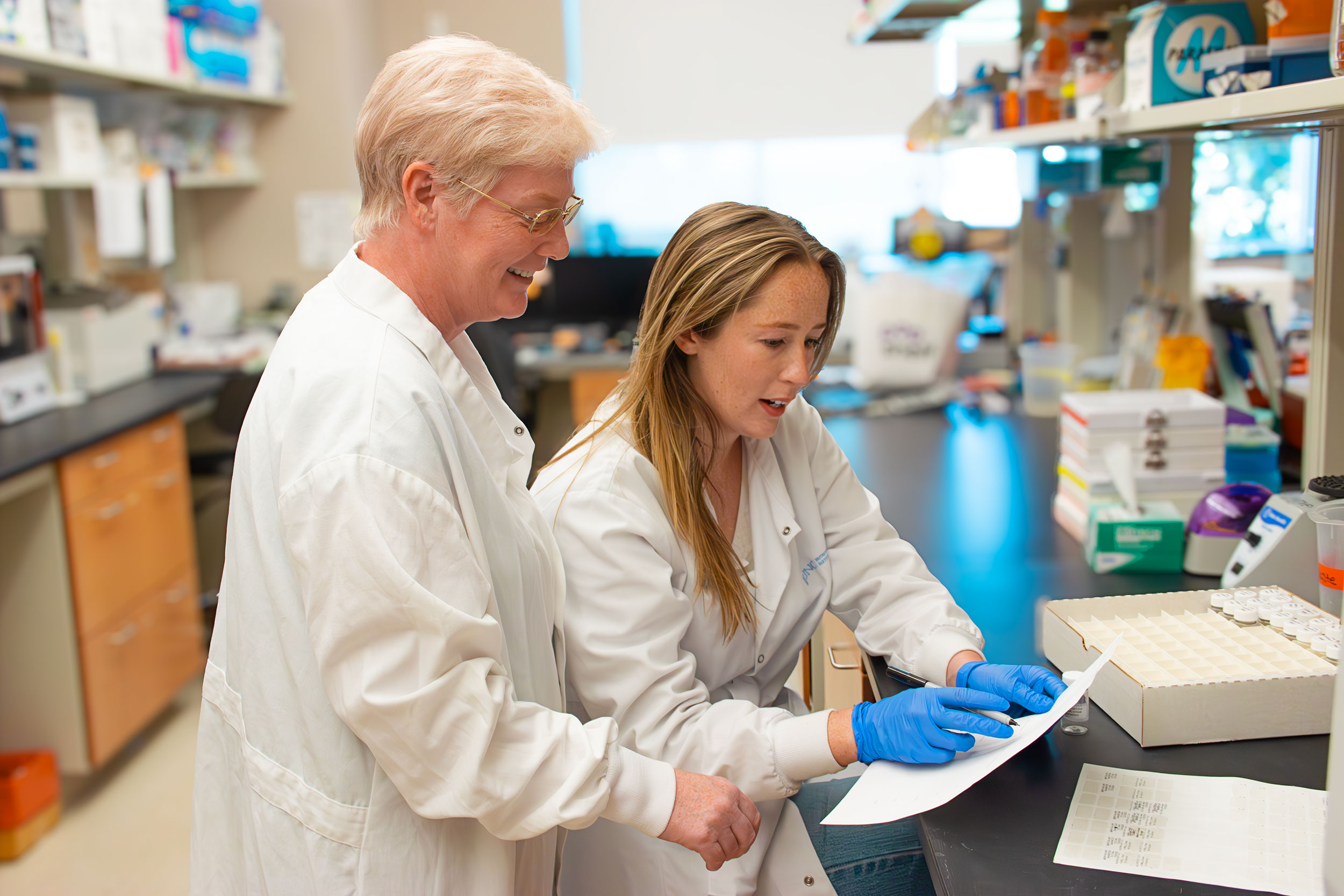
Sandra Mooney, PhD, is an Associate Professor of Nutrition at the University of North Carolina at Chapel Hill’s Nutrition Research Institute. Her research explores how genes and environment affect brain development, focusing on prenatal alcohol exposure and nutrition-based interventions.
Research by: Sandra Mooney, PhD
The Challenge
The brain does not develop all at once.
Before birth, billions of neurons are forming, moving, and organizing into complex networks. Years later, adolescence brings another period of rapid change as the brain refines systems involved in judgment, decision-making, impulse control, and adapting to new situations. Both stages are periods of extraordinary development — and vulnerability.
Scientists know that prenatal alcohol exposure can produce lifelong changes in brain development and behavior. Alcohol exposure during adolescence can also affect the developing brain.
But what happens when exposure occurs during both periods? Does the second exposure simply add another layer of risk, or can the two interact in a way that produces a different, more severe effect?
The Discovery
NRI researchers and their collaborators tested what they call a developmental “double hit” of alcohol exposure.
Using experimental models, researchers compared animals exposed to alcohol prenatally, during adolescence, during both periods, or during neither.
They then examined executive function — the mental skills that allow us to regulate behavior, hold information in mind, change strategies, and make goal-directed decisions.
The researchers evaluated three areas:
- Inhibitory control: the ability to suppress or regulate a response.
- Behavioral flexibility: the ability to recognize that circumstances have changed and adjust behavior accordingly.
- Working memory: the ability to temporarily hold and use information.
Rodents exposed to alcohol during both prenatal development and adolescence showed altered executive-function performance compared with those that had not been exposed or experienced only a single developmental exposure.
The clearest pattern emerged in behavioral flexibility. In both rats and mice, double exposure resulted in more errors and/or attempts before successfully adapting to changing conditions.
Researchers also observed evidence of impaired inhibitory control in double-exposed rats. Rather than reproducing the effects of one exposure or the other, the combined exposure produced a distinct pattern of executive-function changes.
“What surprised us was that an exposure with no measurable effect on its own could produce a striking negative effect when combined with a later exposure. It shows how experiences before birth may prime the body, shaping how we respond to challenges later in life.”
— Sandra Mooney, PhD
Why It Matters
Executive function touches nearly every part of daily life. It helps us stop before acting impulsively, remember and use information, shift strategies when something is not working, plan ahead, and adapt to change.
Deficits in these skills are among the challenges that can affect people with fetal alcohol spectrum disorders.
This study does not tell us that the same outcomes will occur in people who experience prenatal and adolescent alcohol exposure. Instead, experimental models allow researchers to investigate a question that could never ethically be tested in humans: How do alcohol exposures during separate stages of brain development interact?
The findings suggest that developmental timing matters. A brain affected by an earlier exposure may not respond to a later exposure in the same way as a brain encountering alcohol for the first time.
Understanding those interactions could help researchers identify periods of heightened vulnerability and, eventually, opportunities to protect or support healthy brain development.
The larger lesson extends beyond alcohol itself: our developmental history may influence how the brain responds to what comes next.
Share on Socials
Inspired By What You Read?
NRI scientists are discovering how genes, environment, and microbiome affect our individual requirements for nutrients so that, soon, medical practitioners will be able to guide people in their health from childhood through old age without adding to these tragic numbers. Our critical research depends on the generosity of people like you.