
From Gap Year to Groundbreaking Research: Brendon Coats Recognized with First-Generation Student Research Award
May 7, 2026
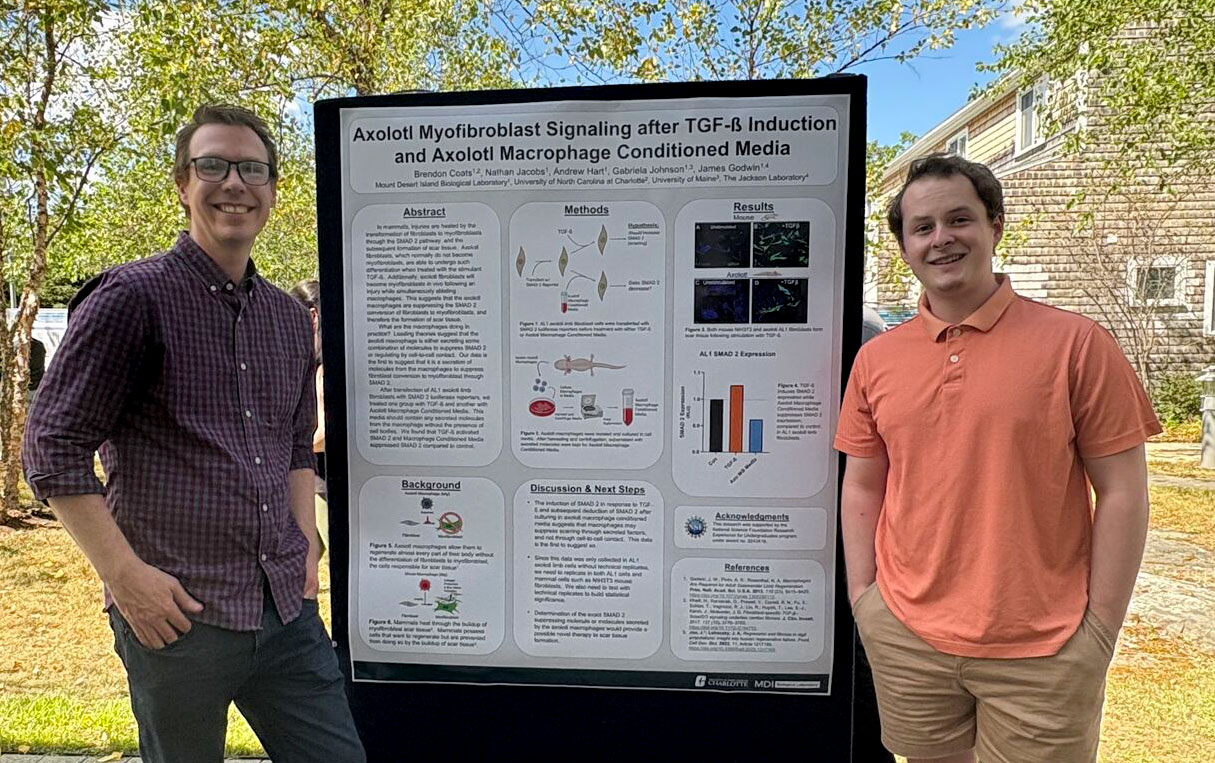
Brendon Coats is currently pursuing a BS in Biology at the University of North Carolina at Charlotte. He started at the NRI as an intern in January of 2022, and now is a Research Technician in the Smith Lab, where he is excited to gain experience in the research field. He hopes to enroll in graduate school and earn his master’s after UNC Charlotte.
The Smith laboratory studies the molecular mechanisms by which dietary components affect prenatal development. Current work largely focuses upon alcohol and how it causes Fetal Alcohol Spectrum Disorders (FASD). They are interested in how alcohol damages the embryo and fetus, and in the environmental and genetic factors that attenuate or heighten alcohol’s toxicity.
When Brendon Coats graduated high school, he did not have a clear plan for what came next. Today, he is an undergraduate biology student at UNC Charlotte, a Research Technician in the Smith Lab at the UNC Nutrition Research Institute (NRI), and a recipient of the First-Generation Student Research Award—an honor recognizing both academic achievement and research excellence.
His path into science did not begin in a classroom. It began during a gap year, when a connection led him to an internship at the NRI’s Clinical Research Center.
“I had no idea what I wanted to do with my life,” Coats said. “When I first started at the NRI, I fell in love with science because of the ability to push human knowledge farther than it had been before.”
That early exposure proved pivotal. What started as an internship quickly grew into a hands-on role in the Smith Lab, where Coats began by helping maintain a zebrafish colony. Over time, his responsibilities expanded to include active participation in research projects, an experience that ultimately shaped his academic direction.
Now pursuing a Bachelor of Science in Biology, Coats credits his time at the NRI with setting him on a clear path toward a career in science. After graduation, he plans to apply to biomedical PhD programs, with the goal of studying regenerative biology.
At the NRI, Coats contributes to research focused on understanding how alcohol exposure during pregnancy affects early development. His work explores how these exposures influence cellular processes and growth, with the long-term goal of improving outcomes for children.
“On a day-to-day basis, I help to find the ‘how and why’ behind damage caused by mothers drinking alcohol during pregnancy,” he said. “The discoveries that we make will make a real difference for real people down the road.”
In addition to his work at the NRI, Coats has gained research experience beyond the Institute. He spent last summer at the MDI Biological Laboratory, where he investigated how the immune system of the axolotl—a species known for its remarkable ability to regenerate limbs—supports tissue regrowth without scarring. The project deepened his interest in regenerative biology and strengthened his research portfolio.
His growing body of work contributed to his selection for the First-Generation Student Research Award, which recognizes UNC Charlotte students who are the first in their families to attend college and have demonstrated excellence in research. Applicants are evaluated based on their research experience and presentations over the academic year.
For Coats, the recognition is meaningful not only for his academic accomplishments, but also for what it represents.
“Being a first-generation college student means paving a way for yourself and those after you,” he said. “It has not been easy to navigate higher education on my own, but the effort has been returned in the form of breaking barriers and creating a roadmap for my future family.”
That determination has not gone unnoticed by his mentors.
“Brendon’s growth as a scientist has been remarkable,” said Dr. Susan Smith, Professor of Nutrition at NRI. “He came to us with curiosity and a willingness to learn, and he has developed into a thoughtful researcher who is contributing in meaningful ways. His drive and perspective as a first-generation student bring something truly valuable to our work.”
Beyond the lab, Coats says his experience at the NRI has even influenced his everyday life, including how he thinks about health and nutrition. More importantly, it has affirmed that he belongs in science.
“My time at the NRI confirmed to me that this is a career where I can thrive,” he said. “I have mentors here who push me to conduct research at a high level and to pursue opportunities I would not have considered before.”
As he looks ahead to the next step in his academic journey, Coats carries with him not only technical skills and research experience, but also a sense of purpose, one shaped by discovery, mentorship, and the opportunity to contribute to work that can improve lives.
For students considering a similar path, his advice is simple: “Give it a shot. There is a field of research for everyone.”
Share on Socials
Inspired By What You Read?
NRI scientists are discovering how genes, environment, and microbiome affect our individual requirements for nutrients so that, soon, medical practitioners will be able to guide people in their health from childhood through old age without adding to these tragic numbers. Our critical research depends on the generosity of people like you.