
Blake Rushing, PhD, Launches Independent Laboratory at the NRI
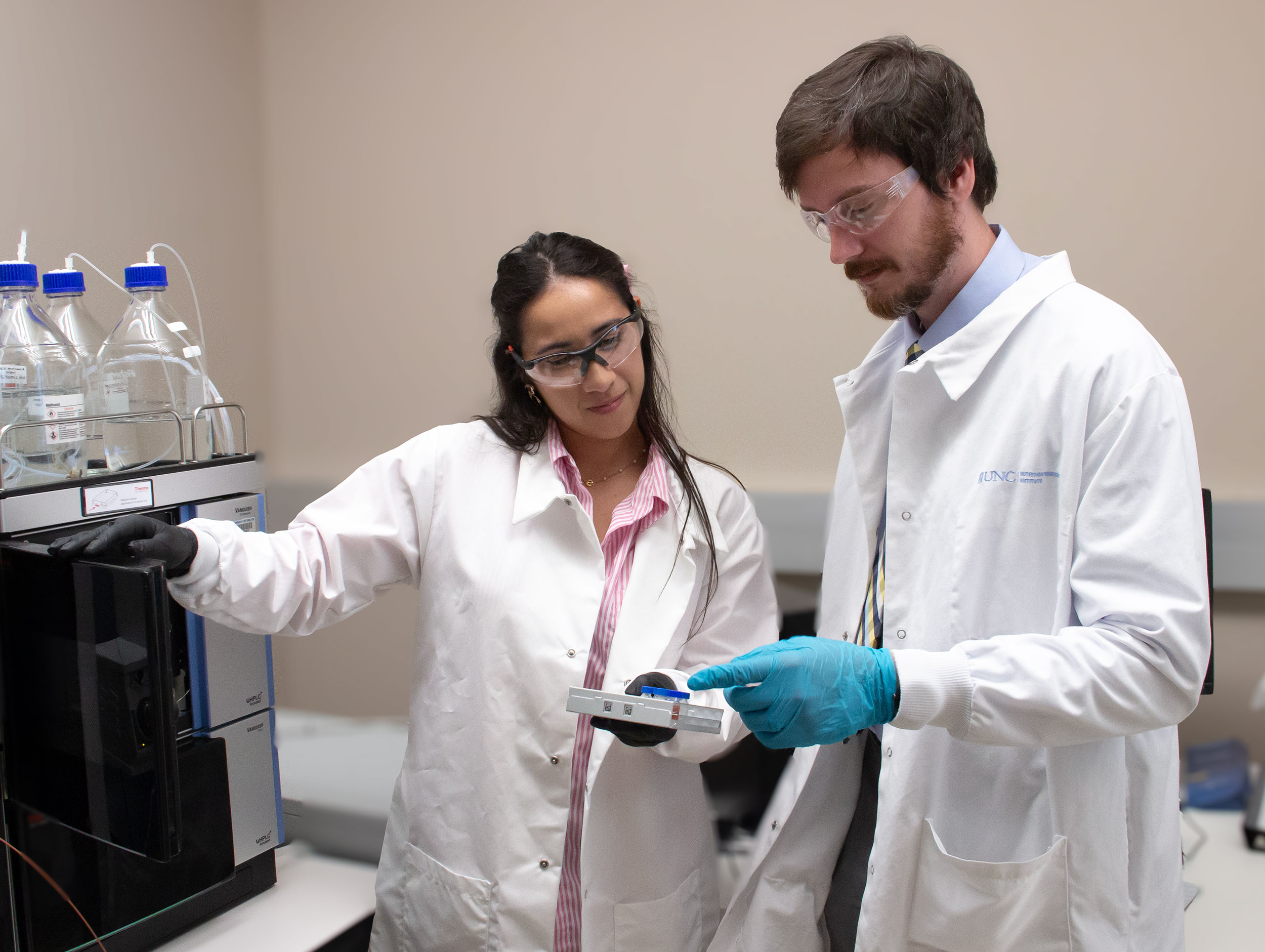
Blake Rushing, PhD, is an Assistant Professor at the University of North Carolina at Chapel Hill’s Nutrition Research Institute, where he leads a research program using multi-omics approaches to study how nutrient metabolism influences cancer and other chronic, age-related diseases. He also serves as Associate Director of the NRI’s Metabolomics and Exposome Laboratory, supporting NIH-funded precision health initiatives including HHEAR and Nutrition for Precision Health.
The UNC Nutrition Research Institute (NRI) is proud to recognize an important milestone in the career of Blake Rushing, PhD, Assistant Professor of Nutrition. Rushing now leads his own research program, marking the beginning of a new chapter in his work at the NRI. His laboratory focuses on understanding how nutrient metabolism shapes cancer development and treatment response. This advancement reflects the University’s continued investment in his work and affirms the significance of his research contributions.
Rushing’s career has been distinguished by rapid progress and major accomplishments. A graduate of Catawba College (BS, Chemistry) and East Carolina University (PhD, Pharmacology and Toxicology), he has trained with leading mentors in cancer biology, pharmacology, and metabolomics. Today, he directs a laboratory that applies advanced multi-omics approaches—integrating metabolomics, genomics, transcriptomics, proteomics, and lipidomics—to uncover how nutrient metabolism influences cancer progression, therapy resistance, and opportunities for precision treatment.
Rushing has secured an R01 grant from the National Cancer Institute, which is the US government’s lead agency for cancer research and is part of the National Institutes of Health. Obtaining an R01 grant is a mark of distinction in the biomedical sciences and is a testament to the rigor and promise of his research. This grant is a $3.9 million award to create the Human Cancer Metabolome Atlas, the first large-scale effort to map the metabolic signatures of tumors across cancer types. This national resource will provide scientists with new insights into how cancer cells reprogram metabolism, opening doors to more effective prevention and treatment strategies.
Institute leadership notes that this milestone reflects both Rushing’s accomplishments and the NRI’s commitment to supporting rising scientists. “Dr. Rushing has distinguished himself as an innovative scientist whose work strengthens the NRI’s mission and advances the field of precision health,” says Deborah Tate, PhD, Interim Director of the NRI. “This milestone is well earned, and we are delighted to see his research program continue to grow.”
Rushing’s impact extends beyond his own lab. As Associate Director of the NRI’s Metabolomics and Exposome Laboratory (MEL), he supports a wide range of precision health initiatives, including NIH programs such as HHEAR (Human Health Exposure Analysis Resource) and Nutrition for Precision Health (NPH). His work bridges disciplines, linking cancer biology, analytical chemistry, and nutrition science in pursuit of a more personalized approach to medicine.
“Throughout my career, I have been fortunate to learn from mentors who encouraged curiosity, rigor, and collaboration,” says Rushing. “Leading my own research program is an exciting step, and it allows me to bring together the training and experiences that have shaped my work. It has also allowed me to bring in an amazing team of scientists to further our research goals to learn more about cancer, metabolism, and nutrition. I am grateful for the support of the NRI community and look forward to contributing to the field in new ways.”
With this new opportunity, Rushing is poised to shape the future of precision oncology and continue making discoveries that advance both science and patient care. His work exemplifies the NRI’s role as a hub for pioneering faculty, where cutting-edge metabolomics and nutrition science converge to create resources and insights that benefit the wider scientific community.