
When Biology, Not Willpower, Predicts Weight Loss
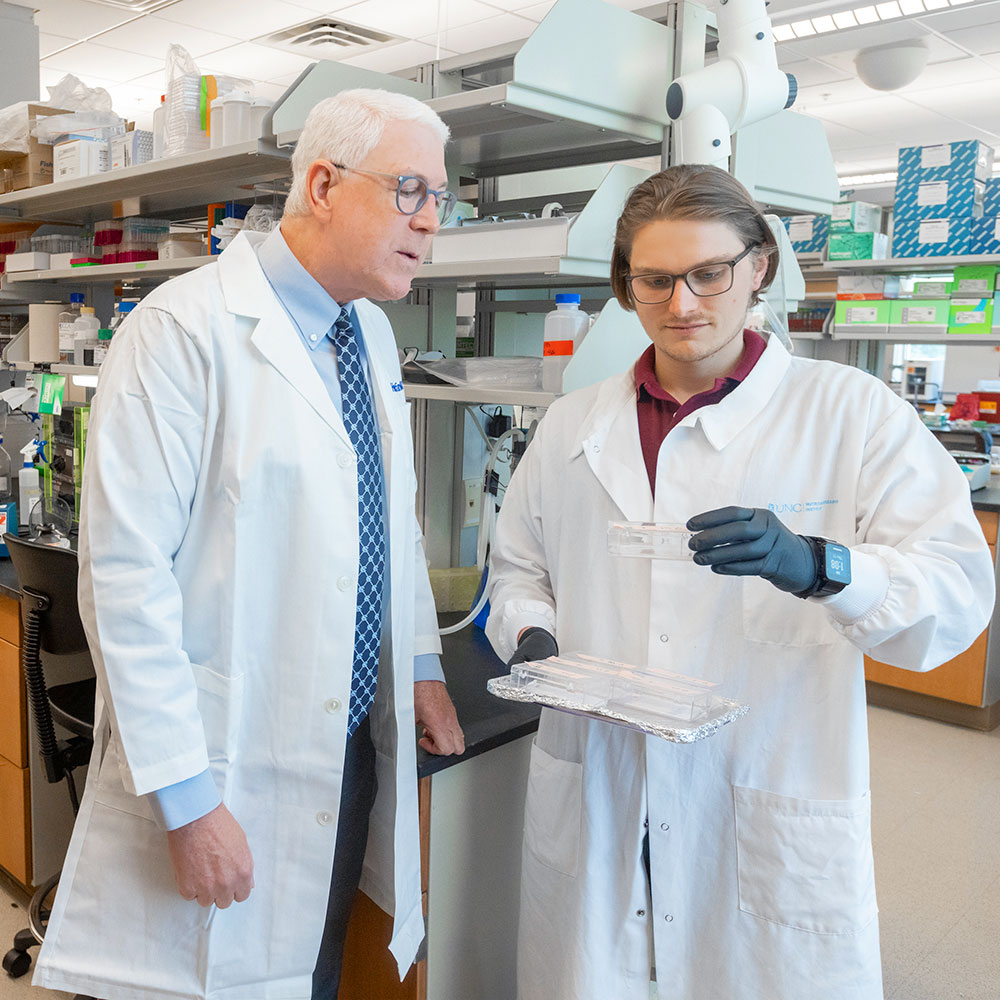
Stephen D. Hursting PhD, MPH, is a Professor of Nutrition at the UNC Nutrition Research Institute in Kannapolis, NC. He is also Professor in the Department of Nutrition and the Lineberger Comprehensive Cancer Center at the University of North Carolina at Chapel Hill. An international leader in the area of nutrition, obesity, metabolism and cancer, his lab focuses on the molecular and metabolic mechanisms underlying obesity-cancer associations, and the impact of obesity- energy balance modulation (eg, calorie restriction and exercise) or pharmacologic agents on cancer development, progression, and responses to chemotherapy.
Evan Paules, PhD, joined the NRI in August 2016 as a doctoral student under the mentorship of Dr. Zeisel. Currently a postdoctoral research fellow in the Hursting Lab, Evan is investigating the determinants of heterogenic responses to dietary interventions in individuals. Evan attended Rider University where he graduated with a double major in Biochemistry and Behavioral Neuroscience.
Can your body predict how well you will lose weight—before you even start dieting? New research led by scientists at the UNC Nutrition Research Institute (NRI) suggests that the answer may one day be yes. In a recent study published in PLOS ONE, researchers found that small molecules produced during metabolism—called metabolites—may help predict who will respond best to calorie-restricted diets. The idea that future weight-loss success could be anticipated in advance represents a major step toward more personalized, effective approaches to obesity and metabolic health.
To explore this possibility, the research team studied a genetically diverse group of mice designed to reflect the wide biological variation seen in people. All the mice were first fed a high-fat diet and then placed on the same calorie-restricted eating plan. While some lost significant weight, others lost much less, despite following identical diets. Before the diet began, researchers collected urine samples and analyzed them using metabolomics, a technique that measures small molecules created as the body processes food and energy.
“What surprised us most was that we could see a clear landscape of different metabolites before any weight loss occurred,” said Evan Paules, PhD, the study’s lead author and a postdoctoral research fellow in the Hursting Lab. “Those early signals helped distinguish which mice would later respond well to calorie restriction.
The researchers identified specific metabolites linked to amino acids and energy use that consistently differed between strong responders and weaker responders. Importantly, these molecules did not cause weight loss; instead, they acted like biological clues, offering insight into how each body was already functioning. “This study was about association, not explanation,” Paules explained. “We were asking whether the body’s chemistry could give us a preview of how it might respond to a low-calorie diet.”
The implications are significant. Today, weight-loss recommendations are often one-size-fits-all, even though individuals respond very differently to the same interventions. Being able to predict response ahead of time could eventually help clinicians match people with strategies most likely to work for them, saving time, reducing frustration, and improving health outcomes.
“This type of evidence helps move weight management research towards precision nutrition,” said Stephen Hursting, PhD, MPH, Paules’ mentor and senior investigator on the study. “Instead of relying on trial and error, we aim to use biological signals to guide more personalized and effective weight loss interventions from the start.
While the findings are still early and based on animal research, they underscore the power of discovery-driven science happening at the NRI. By combining advanced analytical tools with innovative study design, NRI researchers are laying the groundwork for future breakthroughs in obesity prevention and treatment. As this work continues, it brings us closer to a future where weight-loss strategies are not just hopeful but informed, individualized, and rooted in science.
Paules, E. M., Trujillo-Gonzalez, I., VerHague, M., Albright, J., Stewart, D., Sumner, S. J., McRitchie, S. L., Kirchner, D., Coleman, M. F., Bennett, B. J., Green Howard, A., Gordon-Larsen, P., French, J. E., & Hursting, S. D., (2025) Urinary signatures are associated with calorie restriction-mediated weight loss in obese Diversity Outbred mice. PLoS One 20(12): e0329422. https://doi.org/10.1371/journal.pone.0329422